At CES 2026, the true power of AI is unleashed – and it promises to be world-building and life-saving.
Artificial intelligence dominated CES 2026, solidifying its place not just in the world of technology, but in everyday life. Any lingering doubt about AI’s impact has been put to rest, as industry leaders increasingly liken its importance to that of electricity itself. As Gary Shapiro, CEO and Vice Chair of the Consumer Technology Association, said in the CES opening keynote: “AI is transforming every industry, and companies that can scale AI in the physical world will define the next era of human progress.”
With more than 4,100 exhibitors spread across 13 venues in Las Vegas, CES 2026 marked a noticeable shift from previous years. Companies no longer needed to explain how their products incorporated AI – it was simply assumed. This moment signals the beginning of a vision articulated by Siemens CEO and President, Roland Busch: “A world so defined by AI that you will no longer notice it anymore.”
From new interfaces and longevity tech to AI companions and next-gen AI-powered storyworlds, CES 2026 offered a preview of what will shape companies, industries, and daily life over the next decade.
"We're just starting to realize the power of AI, and you ain’t seen nothing yet," said Lisa Su, Chair and CEO of AMD, in her CES keynote.
Read on for our top takeaways from CES 2026.
01. Justine Ezarik (iJustine) interacting with a product at CES 2026 Unveiled 02. LG at CES 2026 03. Lenovo at the Sphere CES 2026
Tech innovations for improving human lives are shifting from health metric measurement to proactive care. “One of the most profound measures of progress is quality of life,” said Brian Comiskey, CTA Futurist and Senior Director of Innovation & Trends, “and right now, technology is redefining our pursuit of improved quality of life.” Longevity tech featured among the mega trends highlighted by Comiskey this year, who noted health tech’s shift in purpose to extend and better people’s lives.
At-home health tech company Withings debuted its Body Scan 2, deemed “the world’s first science-backed longevity station" that's launching in the second quarter of 2026. The scanner tracks over 60 biomarkers including hypertension risk, cardiac pumping efficiency and metabolic health. Speaking to VML Intelligence, Caroline Lagarde, Product Manager at Withings, says the Withings Body Scan 2 has 98% correlations with the full body Dexa scan typically found in health clinics and is able to assess an individual’s health trajectory. "We tell you whether you need to improve your everyday life and give you concrete next steps to improve your longevity," she said.
Several smart rings were on display at CES including FDA-approved Bond Ring, RingConn Gen 3 that incorporates haptic alerts, and Mentoring 2, a ring that focuses on emotional wellbeing. The OG of smart rings, Oura, had its CEO, Tom Hale, at the show. During a panel discussion, he said: “I think sensing is most powerful when you make something that’s invisible or not perceptible to someone, visible," such as blood sugar or hormone levels, which will arm people with more understanding and agency when it comes to their health.
During Samsung’s keynote, Praveen Raja, Vice President of Digital Health at Samsung Research America, said their vision is to "shift from reactive care to proactive care” with what they call, “intelligence care.” And similarly, on a panel during AMD’s keynote, Sean McCain, Founder and CEO of biotech company Absci, said he wants to live in a world that shifts “from sick care to preventive care to ultimately regenerative biology and medicine where aging no longer is linear."
“AI is going to help us create it," he said.
One of the most profound measures of progress is quality of life, and right now technology is redefining our pursuit of improved quality of life.
Brian Comiskey
CTA Futurist
01. Oura ring 02. Withings Body Scan 2 03. Samsung keynote at CES 2026
2. New Interfaces
Vocci note-taking ring
Scanning the exhibits at CES, it felt like walking into a Warby Parker – glasses en masse, but of course, this is a technology show, meaning the eyewear is embedded with smarts. Alongside the major players like XReal and Ray-Ban Meta, a lot of startup tech was on display. China’s LLVision launched its Leion Hey 2 AR glasses, a dedicated professional translation device that supports over 100 languages and accents. Inmo Air3 claims to be the world’s first and only all-in-one 1080P full-color waveguide that comes with a touchpad and control ring. And the Vuzix Ultralite Pro Enterprise Platform prescription-ready AR glasses (designed for the workplace) were recognized as an honoree at the CES Innovation Awards. These advancements highlight the burgeoning field of wearable technology.
But it’s not just glasses shifting our attention away from screens. Naqi Logix won “Best of Innovation” at CES 2026 for its Naqi Neural Earbuds that enable responses to subtle gestures such as head tilting or blinking. Lauren Jacques, a Naqi Logix representative, tells VML Intelligence: “This earbud is more than just for listening to music. It can be used to control and command your world with facial features. It’s a non-invasive alternative to a brain implant.” Another company, Neuranics, debuted its MiMiG, a multi-channel magnetomyography (MMG) wristband with advanced sensors, allowing people to use intuitive gestures to be deployed for various applications such as XR, wearables and machine control. Vocci is an AI note-taking ring that can record and transcribe conversations as well as offer summaries and highlights.
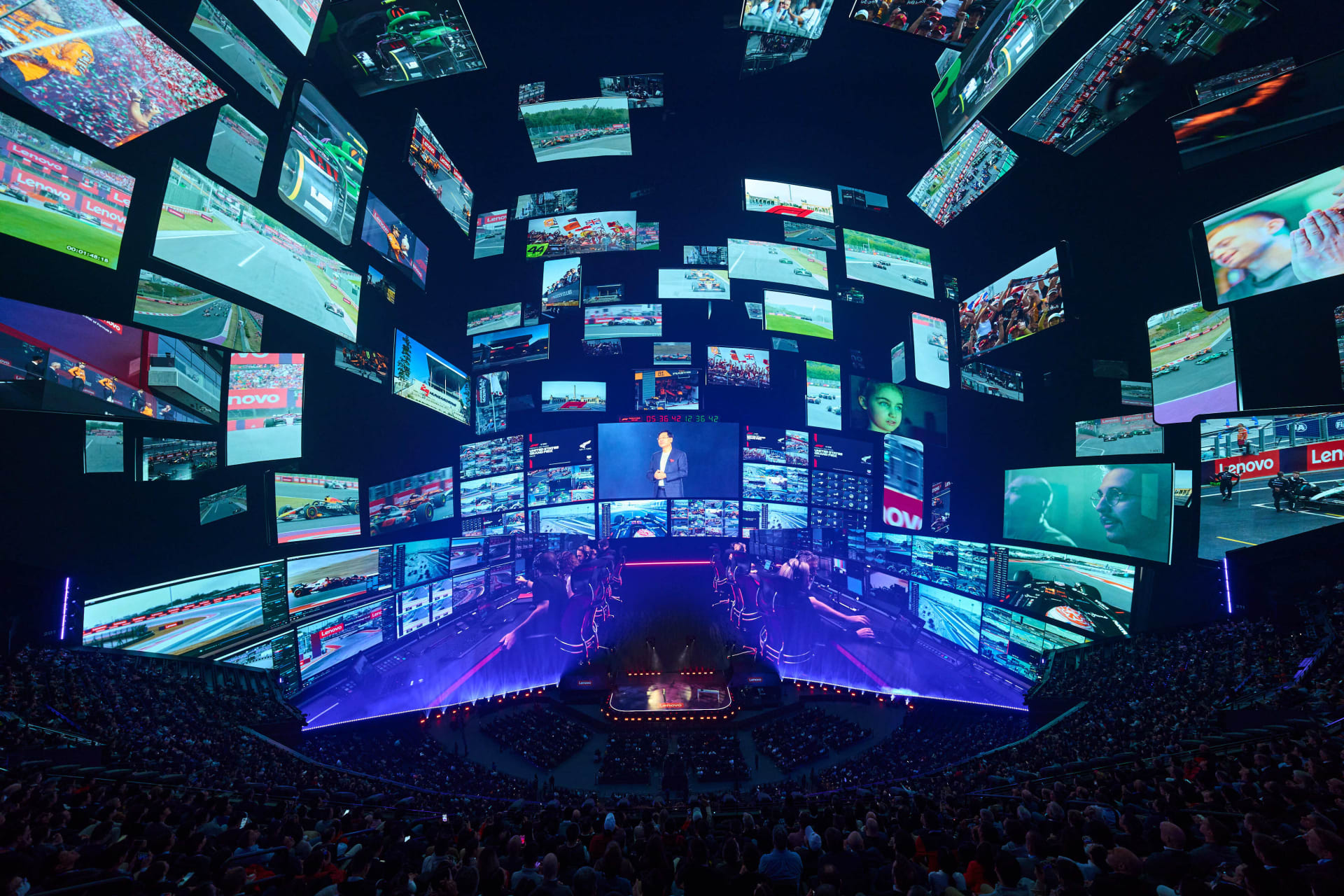
Meanwhile, Lenovo debuted Qira, its AI-powered personal assistant that is designed to work across Lenovo and Motorola devices. During the keynote demonstration at the Sphere in Las Vegas, Qira was not only shown across existing devices, but also as a pendant concept as well. Dan Dery, VP of AI Ecosystem in Lenovo’s Intelligent Devices Group, said in a release: “Lenovo Qira is not another assistant, it’s a new way intelligence shows up across your devices.” He added: "Our goal is to make AI feel less like a tool you use, and more like an intelligence that works with you, continuously and naturally.” Qira is expected to be rolling out in Q1 of 2026.
Qualcomm’s CEO and president, Cristiano Amon, also believes the future of AI-devices will be seamlessly integrated into the fabric of our everyday. At CES, he said: “The reason we talk about wearables as personal AI devices is because humans have already decided what they’re going to wear, and it’s going to be glasses, jewelry, pendants, rings, bracelets and pins. And this is the opportunity for the tech industry to merge with the fashion industry.”
01. Inmo Air 3 02. Neuranics MiMiG wristband 03. Naqi model 3
3. Smart Play
Toys for Gen Alpha and Beta are up-leveling thanks to tech, with many companies on a mission to make sure playtime is interactive, imaginative and social. This sector also hinted at exciting developments in gaming tech.
Lego’s debut at CES did not disappoint tech fans as they announced the Lego Smart Brick, which looks like the standard Lego brick but has integrated tech features including lights, speakers and sensors. The company’s mission, as Julia Goldin, Chief Product & Marketing Officer and EVP of the Lego Group, said at the CES media keynote speech, is to “create more interactivity, create new dimensions of play by bringing in technology, and seamlessly integrate it into physical bricks and physical play.” It's also part of the Smart Play platform, where Lego bricks, tags and mini-figures can connect as one interactive open system, offering opportunities for social play. Ultimately, Goldin believes, Lego Smart Brick and Smart Play will "unlock opportunities for interactivity, new dimensions of responsiveness, opportunity for more social play and more storytelling.” Fans can pre-order now ahead of shipments in March.
Smart companions were everywhere at CES, with many hailing from China. Switchbot had Kata Friends AI-plush toys on display, while Japanese start-up Ludens AI was at Eureka Park with its Cocomo prototype smart toy aimed at parents and kids, with plans to raise funding this year to bring the project to life. Meanwhile, Yonbo X1 companion robot by Chinese company X-Origin AI is a family robot designed to promote interactions, empathy and education. And the very cute AiMe robot for kids by TCL showcased a variety of looks at the Las Vegas Convention Center, with a company representative explaining how it's a companion that focuses on emotions and that AiMe will be launching in the second half of the year. These are prime examples of the growing segment of companion robots.
Our mission is to create more interactivity, create new dimensions of play by bringing in technology, and seamlessly integrate it into physical bricks and physical play.”
Julia Goldin
Chief Product & Marketing Officer, EVP, Lego Group
4. Humanoids at Scale
Atlas humanoid by Boston Dynamics and Hyundai
Robotics was highly visible at CES, taking to the showroom floors and keynote stages as companies proudly showed off the slick progress made to turn home and industry robots into truly practical helpers. For the home, LG Electronics launched the LG CLOiD robot as part of its wider “zero labor home” vision, and Singaporean robotics company Sharpa debuted its humanoid called North featuring its SharpaWave robotic hand, which is designed to match the size and dexterity of the human hand. Live demonstrations showed how human-like the SharpaWave hand is, including folding a windmill from paper and dealing cards at a blackjack table (appropriate for the Las Vegas setting!)
The most significant impact for humanoids will be seen in factory environments. NEURA Robotics humanoid4NE1 promises “human-like fluidity” and during CES it unveiled a smaller version. Hyundai and Boston Dynamics showcased the latest version of their Hyundai Atlas humanoid, expected to be deployed at Hyundai factories by 2028. In addition, Hyundai announced plans to build a factory dedicated to producing 30,000 Atlas robots per year. Seunghyun Woo, Future Strategy Team lead at Hyundai Motor Group, believes that “robots have to prove themselves in the factory first, then they are allowed to do the housework in the home.” Fueling much of this technology is Nvidia, whose President and CEO, Jensen Huang, announced new frameworks, AI infrastructure and open models for physical AI while accompanied on stage by several robots from Nvidia’s global partners.
01. LG CLOiD 02. Atlas humanoid by Boston Dynamics and Hyundai
5. Physical AI Arrives
Lisa Su CEO of AMD
Chip makers, racks and AI infrastructures took center stage this year at CES, as leading keynotes geeked out on behind-the-scenes tech that allows for fast compute speed and seamless integrations. Large numbers were thrown about – millions, billions and trillions are not enough. Enter "yotta" – the equivalent of one septillion. AMD’s Lisa Su explained how AI adoption and innovation are accelerating compute demand, and how companies like hers are now working towards "yotta-scale" AI capabilities with products such as the Helios open rack platform to allow for AI at scale and make physical AI possible.
Last year, Jensen Huang said “the ChatGPT moment for general robotics is just around the corner.” This year, he announced that it's here thanks to “breakthroughs in physical AI” that deliver models that understand the real world and can reason and plan actions. Bringing along two small and very cute robots onto the stage, Huang showed how robots learn how the physical world works digitally via Omniverse (a real-time 3D design and simulation platform) before being created physically. "Robots will be one of the industries revolutionized by physical AI," he said.
Qualcomm launched the Dragonwing IQ10 Series, a robotics processor that can power robots and humanoids. “By building on our strong foundational, low-latency safety-grade high-performance technologies ranging from sensing and perception to planning and action, we’re redefining what’s possible with physical AI by moving intelligent machines out of the labs and into real-world environments,” said Nakul Duggal, Executive Vice President & Group General Manager, Automotive, Industrial & Embedded IoT and Robotics at Qualcomm Technologies.
AI is going to be everywhere over the next few years, and most importantly, AI is for everyone.
Lisa Su
Chair & CEO, AMD
01. Lisa Su CEO of AMD 02. Jensen Huang CEO of Nvidia 03. Nvidia global partners
6. AI-Powered Storyworlds
Luma AI featuring Ray3 Modify
The power of Physical AI extends into storytelling, transforming the way stories are told, visualized and felt. Luma AI is working with AMD to “build multi-modal general intelligence so AI can understand our world and help simulate and improve it,” said Amit Jain, CEO & Co-Founder of Luma AI. Working with large enterprises across advertising, media and entertainment to help them better tell their stories, Jain shared how “filmmakers and creators can create entire cinematic universes now without elaborate sets, and then edit and modify anything to get the resulting output.” In addition, he explained how Luma’s team is building “the world’s most powerful multimodal agent models” that will make “individuals or small teams suddenly have the power of doing what entire Hollywood studios do.” This development also has significant implications for future gaming tech.
The "Godmother of AI" and Founder of World Labs, Dr. Fei-Fei Li, hit the stage to share her excitement around a new wave of technology that can “finally give machines something closer to human-level spatial intelligence,” she said.
“It’s the ability to perceive and create 3D or even 4D worlds, reason about objects and people, and imagine entirely new environments that still obey the laws of physics in worlds that are virtual or real.”
World Labs was launched to bring spatial intelligence to life and allow people to easily create expansive 3D worlds that are fully navigable and cohesive. With just a few simple inputs from users, such as images or prompts, entire worlds can be generated. The future of storytelling has arrived.
This is the beginning of a new chapter when technology and humanity synergize, and the digital and physical worlds finally come together.
Yuanqing Yan
CEO & Chairman, Lenovo
01. Luma AI featuring Ray3 Modify 02. Lisa Su CEO of AMD with Fei-Fei Li of World Labs
What It Means for Brands
Lenovo at CES
CES didn't just showcase innovations – it unveiled a paradigm shift. The brand technologies revealed, coupled with companies' ability to deploy them at scale, are set to fundamentally transform consumer experiences in 2026 and beyond.
At CES, it was evident how big tech visions have moved from the theoretical to practical. From workplace efficiencies and prolonging healthspans to solving the world’s most complex problems, AI is powering these possibilities. That said, the human touch remains integral. "Great technology is created by people who care about people,” said TM Roh, Samsung CEO and President, Device eXperience Division.
CES showcased how society is evolving alongside the trillion-dollar business of AI. "This is the beginning of a new chapter when technology and humanity synergize, and the digital and physical worlds finally come together," said Lenovo’s Chairman and CEO, Yuanqing Yang. The message is clear: If you thought developments in 2026 would slow down, think again.
Answers to your CES questions:
At CES 2026, Artificial Intelligence truly dominated the event, with its importance increasingly likened to "electricity itself." AI has solidified its place beyond just technology, becoming integrated into everyday life to the point where, as Siemens CEO Roland Busch stated, "you will no longer notice it anymore." A key advancement was the move towards "yotta-scale AI capabilities" for accelerating compute demand, as explained by AMD’s Lisa Su. Furthermore, breakthroughs in "physical AI" were highlighted, enabling models to understand the real world, reason and plan actions – marking a significant step in AI's ability to operate in the physical domain.
CES 2026 prominently featured physical AI and robotics. In "Humanoids at Scale," LG introduced the CLOiD robot for a "zero labor home" vision, Sharpa debuted its humanoid North with a human-like robotic hand, and NEURA Robotics showcased its humanoid4NE1. Hyundai and Boston Dynamics presented the latest Atlas humanoid, planned for factory deployment by 2028 with a dedicated factory to produce 30,000 units annually. Qualcomm also launched the Dragonwing IQ10 Series, a robotics processor designed to power robots and humanoids, enabling them to move from labs into real-world environments. Additionally, smart companions like Yonbo X1 and AiMe robots for kids were on display.
Longevity Tech at CES 2026 demonstrated a significant shift from mere health metric measurement to proactive care aimed at improving and extending human lives. Withings debuted its Body Scan 2, hailed as "the world’s first science-backed longevity station," capable of tracking over 60 biomarkers and assessing health trajectory. Smart rings like the FDA-approved Bond Ring, RingConn Gen 3, Mentoring 2 (for emotional well-being), and Oura (making invisible health data like blood sugar levels visible) showcased advanced personal health monitoring. Samsung and Absci both articulated a vision to transition from reactive or "sick care" to "proactive care" and "preventive care," ultimately moving towards "regenerative biology and medicine where aging no longer is linear," with AI playing a crucial role in achieving this.
New interfaces and wearable technologies at CES 2026 are profoundly changing human-tech interaction by moving attention away from traditional screens and integrating technology seamlessly into daily life. This included a surge in smart eyewear, such as LLVision's Leion Hey 2 AR glasses for translation, Inmo Air 3's full-color waveguide with touchpad, and Vuzix's prescription-ready AR glasses. Innovative wearables like Naqi Neutral Earbuds allow control through subtle gestures such as head tilting or blinking, offering a "non-invasive alternative to a brain implant." Neuranics' MiMiG wristband uses advanced sensors for intuitive gesture control, and the Vocci AI note-taking ring records, transcribes and summarizes conversations. The launch of the AI-powered Qira by Lenovo is designed to work across Lenovo and Motorola devices and "moves with you across PCs, tablets, smartphones, wearables, and more," further indicating how humans will increasingly integrate AI into their everyday lives.
Big tech visions have evolved from theoretical concepts to practical applications, impacting everything from workplace efficiencies and extending "health spans" to solving complex global problems. While AI is the driving force behind these possibilities, the "human touch remains integral." CES underscored that society is evolving alongside the "trillion-dollar business of AI," marking "the beginning of a new chapter when technology and humanity synergize, and the digital and physical worlds finally come together." This implies that brands must adapt to increasingly personalized, AI-driven experiences and leverage these advancements for growth, as developments are expected to accelerate.
CES 2026: VML, Mazda & Adobe
Moderated by VML CEO, Jon Cook, this insightful panel explored the future of AI-driven personalized experiences and how Adobe’s unparalleled experience platforms, combined with VML’s cutting-edge customer strategies and the audience-centric marketing expertise of Mazda North American Operations, are driving next-generation personalization at scale.
CES 2026: The Magic of Media With WPP's Brian Lesser
WPP Media CEO, Brian Lesser, led a panel to explore WPP Media’s blueprint for enduring brand growth in the AI-powered economy. Have a read of Brian's "contrarian" take on how in an AI-saturated marketing world, media – not technology alone – determines which brands endure.
For more on how we can help you action our CES takeaways, including our top 100 trends for 2026 from VML's forthcoming Future 100 report, to drive growth opportunities for your brand, you can contact us here: